
In Queensland, the age of dinosaurs feels surprisingly close at hand. From Brisbane, a trail of world-class museums and remote outback fossil fields leads to some of Australia’s most significant prehistoric discoveries. It also serves as the starting point for a journey to Winton, the town widely regarded as Australia’s dinosaur capital.


Credit: John Nguyen

Credit: John Nguyen
Brisbane
2-3 days
Brisbane’s first dinosaur attraction is just outside the airport: the Dinos Alive Immersive Experience at Skygate, where 80 animatronic dinosaurs are joined by virtual reality encounters with marine reptiles, such as the monstrous Mosasaurus.
The city’s epicentre of prehistoric experiences is Queensland Museum Kurilpa , the state’s largest and oldest museum, on the South Bank of the Brisbane River. Its centrepiece, Dinosaurs Unearthed , showcases fossils and interpretive displays refreshed as part of a major refurbishment in 2023.
Here, you’ll come face to face with the fearsome Australovenator, one of Australia’s largest known meat-eating dinosaurs, alongside ichthyosaurs and plant-eating species including Muttaburrasaurus and Kunbarrasaurus – names that’ll reappear throughout your trip. Many of these were named by the museum’s own palaeontologists.
Don’t skip the megafauna galleries. Australia’s Ice Age giants – oversized cousins of today’s wombats and goannas – get their own display of skeletons. Among them is Thylacoleo, the “marsupial lion”, a tree-dwelling ambush predator that still stalked the landscape when the first people arrived some 50,000 to 60,000 years ago.

Credit: DarkSky International

Credit: Australian Age of Dinosaurs Museum

Credit: Australian Age of Dinosaurs Museum
Winton
3 days
While Brisbane is a thriving modern city, the outback is where many of Australia’s most remarkable prehistoric stories begin. From the Queensland capital, either fly to Longreach in just over two hours or take the slower route aboard Queensland Rail’s Spirit of the Outback, a scenic 26-hour journey covering 1,325km. From there, it’s a 180km drive to Winton and the Australian Age of Dinosaurs Museum.
There, you’ll encounter “Australia’s most complete theropod dinosaur”, as palaeontologist Dr Jake Kotevski describes Australovenator, a member of the megaraptorid family found only in Australia and South America. The specimen is known from a near-complete forearm, hind-limb and parts of the lower jaw. The collection also includes massive sauropods like Diamantinasaurus and the pterosaur Ferrodraco, animals only found in the outback of Australia.
The museum’s Ultimate Dinosaur Tour encompasses the Collection Room, Fossil Preparation Laboratory and March of the Titanosaurs exhibition, along with a self-guided walk through Dinosaur Canyon, where life-sized sculptures bring ancient creatures back to the landscape they once inhabited.
Winton is also internationally recognised as a Dark Sky destination, where the stars compete with the fossils for attention. Museum collection manager Mackenzie “Macca” Enchelmaier says city dwellers “don’t realise just how many stars there are. When you come out to a place like this, you can look at the night sky without the light pollution. It’s very impactful and something you’ll never forget.”
Before leaving town, join a guided day trip to Lark Quarry to see stampeding dinosaur trackways preserved amid red earth, spinifex grasses and immense outback skies.

Credit: Reuben Nutt

Credit: Reuben Nutt

Credit: Reuben Nutt
Richmond
1-2 days
About 230km, or three hours’ drive, north of Winton lies Richmond, home to Kronosaurus Korner, a museum dedicated to the prehistoric marine reptiles that once inhabited Queensland’s ancient inland sea. It takes its name from the locally discovered 11-metre-long Kronosaurus, one of the largest ocean predators of its time.
The museum also houses Australia’s most complete pterosaur fossils, along with dinosaur specimens including Muttaburrasaurus, sometimes dubbed the “cow of the Cretaceous”, and the armoured Kunbarrasaurus – arguably Australia’s cutest dinosaur.
Richmond once sat on the edge of a vast inland sea, which explains the extraordinary abundance of fossils found here today. Visitors can dig for their own finds in the township’s open public dig sites and learn how real fossil preparation labs operate at the museum.
As Kronosaurus Korner designer and artist Zev Landes puts it: “There are large sea monsters, there are shark teeth. A whole underwater world is waiting to come out of the ground.”
Hughenden
1-2 days
The final stop on Queensland’s Dinosaur Trail is the town of Hughenden, about 115km, or one-and-a-half hours, east of Richmond. The Flinders Discovery Centre is home to “Hughie” the Muttaburrasaurus, as well as exhibits exploring outback Australian history, volcanic basalt country, fertile black-soil plains and local Indigenous culture.
The displays here are smaller and more intimate than those at earlier stops, making them especially appealing for families. Another highlight is the immersive light and sound show charting the 500-million-year evolution of nearby Porcupine Gorge.
Where to stay
Accommodation ranges from caravan parks to motels and hotels. Book ahead in peak periods.
Credit: Rangelands Outback Camp
Winton
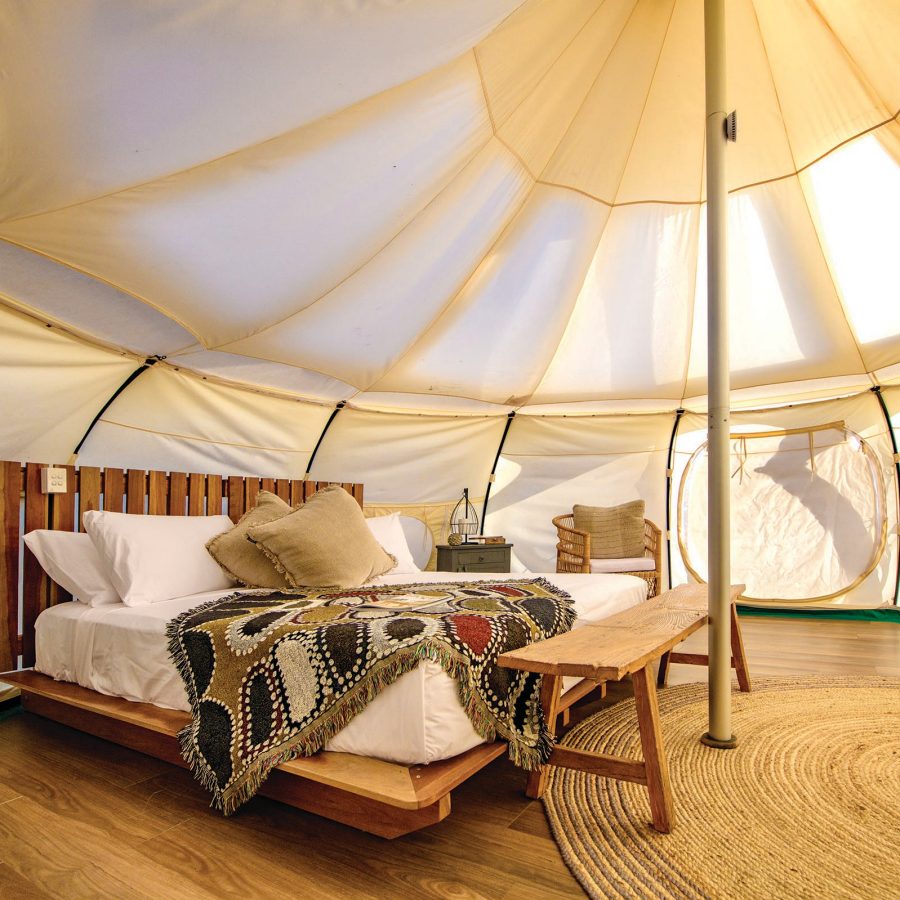
Rangelands Outback Camp , an exclusive six-tent retreat with beds, showers and a private chef.
Richmond
A modest motel selection, including Ammonite Inn , Midway Motel , Mud Hut Hotel and Lakeview Caravan Park .
Hughenden
Royal Hotel Motel offers country-style rooms and family suites within walking distance of shops and restaurants.
Where to eat
Outback Queensland is fuelled by generous counter meals rather than fine dining. Expect classic pub fare and hearty roadhouse meals.
What to know
Outback Queensland is vast, arid and sparsely populated. Hire a suitable vehicle, carry plenty of water and plan your visit between April and September for the most comfortable conditions. The Dinosaur Trail Pass covers entry to the major attractions in Winton, Richmond and Hughenden.